
Thoroughly Modern Magic
Explaining kuji as "hypnotism" doesn't get you very far, but it does reveal something fundamental about 'ninja' history

As we’ve been considering the mystical practice of kuji over the last few posts, we’ve found ourselves bumping into the idea of hypnotism a few times. Usually, a writer offers hypnotism as a potential mechanism for how kuji could have some kind of real physiological effect; or, more broadly, hypnosis is posited as a general explanation for what the writer claims are tales of ‘ninja’ possessing magical powers. It’s quite common overall for modern writers to claim that ‘ninja’ used hypnotism, like on the back of my DVD copy of the 1981 movie Enter the Ninja:
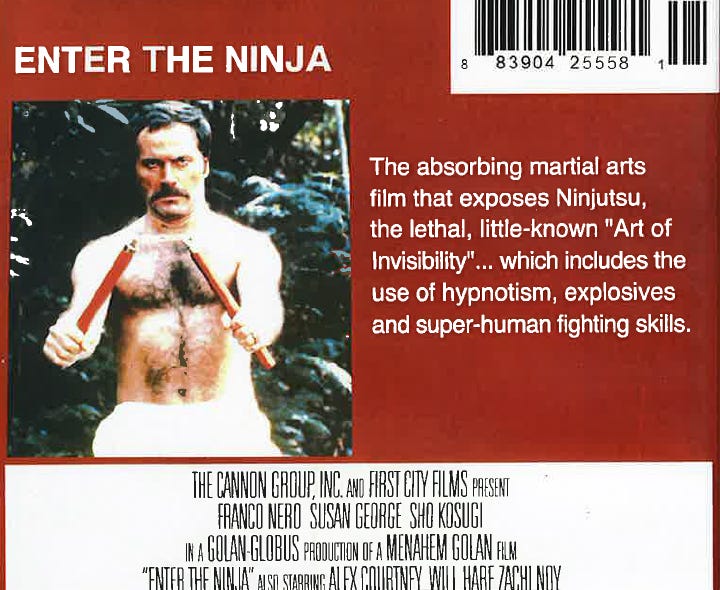
I don’t think the copywriter here had actually seen the film, because as far as I can recall there’s no hypnotism in Enter the Ninja, but whatever.
Anyway, it won’t come as a surprise to hear that I think it’s a load of nonsense to use “hypnotism” as an explanation for what the ‘ninja’ supposedly did. As is so often true with ‘ninja’ stuff, though, the explanations for why an idea is nonsensical end up being much more interesting than the idea itself, and so it is with the “hypnotism” thing too. In fact, as I looked into the topic of hypnotism in Japan, particularly its relevance to ‘ninja,’ I began to realize that there was way more here than I had imagined. It also became clear that exploring the ‘ninja-hypnosis’ question reveals something quite fundamental about what ‘ninja’ writing is trying to do, and so is definitely a productive use of our time.
Going forward, it’ll be helpful to understand the below:
The ‘ninja-hypnotism’ thing emerges at a specific historical and cultural moment in Japan. Hypnotism in general gets a lot of attention in Japan between about 1890 and 1920, because that is a period of great cultural tension. The nature of that tension is that modernization requires rejecting a great deal of Japan’s premodern culture, but at the same time, that is something a lot of Japanese people really don’t want to do.
Introduced to Japan from the West in the mid-19th century, hypnotism seems to offer a solution to this problem. If you assume that premodern stories of religious miracles or magical powers were really hypnosis, then hey presto, you don’t have to junk them completely! Problem solved. Even better, hypnosis is understood as coming from the advanced, scientific West, and is therefore almost automatically respectable.
But. What’s being bandied about as “hypnotism” in Japan during this period is not really “scientific” at all. In practice, it’s still a semi-mystical, occultist practice that just happens to have a superficially plausible veneer of sciency-ness.1 In other words, all that the “hypnosis” explanation does is substitute a modern, respectable form of magic for the premodern one.
Yeah, I know that’s a lot to lay on you first thing on a Saturday morning. So, let’s look at this whole mess in more detail.
Japan’s Hypnotic Modernity
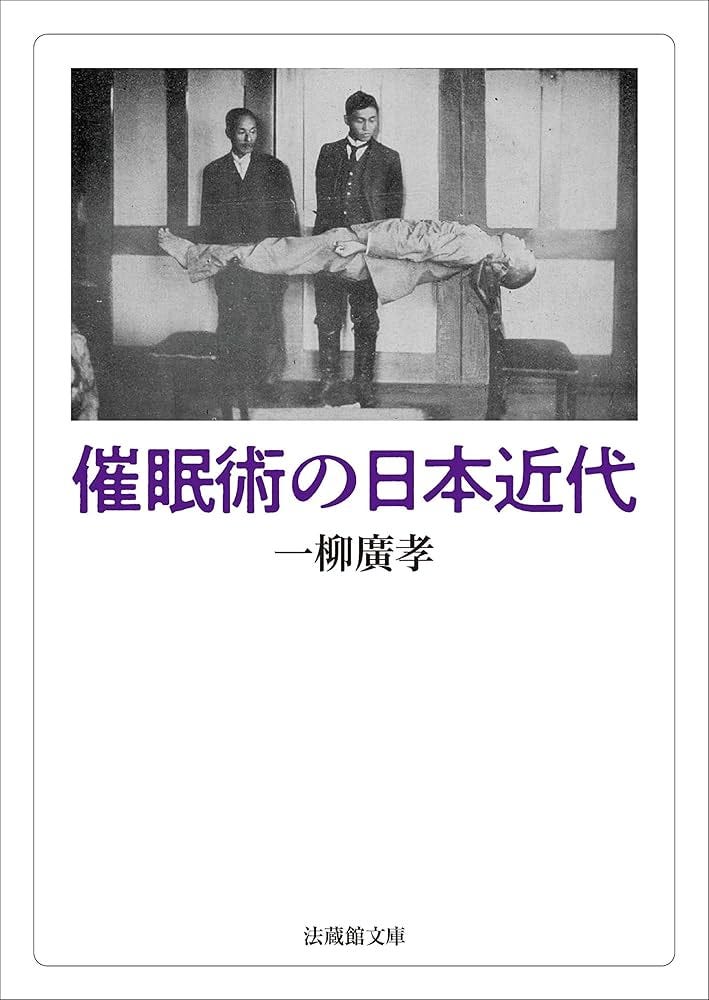
A good place to start is by considering how the notion of hypnosis got to Japan in the first place, and how it was received once introduced. To try to answer that question, I picked up a copy of Japanese scholar Ichiyanagi Hirotaka’s 1996 book Hypnotism and Japanese Modernity (Saiminjutsu no Nihon kindai). It’s a fascinating book that explores the role hypnotism (as well as its precursor mesmerism) played in Japan’s project of modernizing between about 1870 and 1920. For those who are curious, yes, the book does mention ‘ninja’ specifically, but we’ll get to that in due course.
Now, one of the problems with discussing hypnotism is that even today nobody is entirely sure what it is. There are, as you can see for yourself, at least eight different theories as to what’s going on when someone is hypnotized. So depending on how broadly you’re willing to stretch your definition of hypnosis, you could potentially make it apply to a wide variety of phenomena in many historical and cultural contexts, especially if you define “hypnotism” to include any unusual mental state or trance. Ichiyanagi concedes this point a little way into the book:
One can find hypnotism, or phenomena resembling it, from ancient times everywhere in the world…In the Japanese context, we might acknowledge traces of hypnotism here and there, such as in the cases of oracles from the gods, Shugendō, esoteric Buddhism, shrine maidens (miko), the folk shamans of south-western Japan (yuta), Okinawan shamanesses (noro), and the like…2
But as you may realize, defining “hypnotism” in this way broadens it to the point of meaninglessness. It becomes pretty much the same thing as “mysticism,” or, depending on how iconoclastic you’re inclined to be, even “religion” as a whole. In practice, and fortunately for his book, Ichiyanagi doesn’t follow this excessively broad definition of hypnotism. His working assumption is that hypnotism is first and foremost a Western phenomenon, one that emerged in late 18th century Vienna and Paris with Franz Anton Mesmer and was moved somewhat closer to its modern form during the 19th century by a Scottish doctor named James Braid.
This background matters for our discussion in the Japanese context, because it means that the idea of hypnotism in Japan carried a measure of inherent authority from the beginning. The notion of - perhaps even the word - ‘hypnotism’ was a powerful one because it was broadly understood as being “scientific.” And to a great extent, it was understood as being scientific precisely because it was Western.
The Dreaded Hypnotic Hypnosis
Ichiyanagi’s approaching hypnosis as primarily a Western phenomenon allows him to define his subject with some precision, as a phenomenon that has a definite beginning. As he points out, the word now used to mean hypnosis in Japanese, saiminjutsu (literally, ‘provoking sleep technique’) isn’t attested to until as late as 1881, and probably wasn’t in common use in Japan until the mid-1880s. (“Mesmerism” does show up slightly earlier, though, in a dictionary from 1873).3
Ichiyanagi’s observations suggest two things: first, there doesn’t appear to have been a native word equivalent to “hypnotism” in Japan before the Meiji period (1867-1912); and second, that from the start the concept of hypnotism seems to have been understood in Japan as Western-derived knowledge. The linguistic history might seem trivial, but it’s important data in terms of how we need to think about hypnotism in the ‘ninja’ context. For one, the apparent lack of a word for ‘hypnotism’ in premodern Japan suggests caution is warranted with accounts of ‘ninja’ hypnosis like the below by Jay Gluck and Stephen K. Hayes:
One of the arts developed and used by the Japanese ninja and his Chinese ancestor was that of sai-min-jutsu, what we would term in English, hypnosis.4
SAIMINJUTSU: THE NINJA’S POWER OF DIRECTING THE MIND
Tales from the history of the art of ninjutsu include numerous references to saiminjutsu (hypnotism) […]5
A non-specialist reader could easily get the impression that “saiminjutsu” was the term the ‘ninja’ themselves used to describe their practice of hypnosis, or perhaps that “saiminjutsu” as a specific term appears in medieval primary sources. What Ichiyanagi shows us, though, calls both notions into question. If hypnotism doesn’t appear in Japan until the late-19th century, as seems to be the case, both Gluck and Hayes’ invocation of hypnotism is probably anachronistic. They’re taking a modern, Western concept and assuming that it can be just air-dropped unproblematically on medieval Japan, which seems…debatable.
It’s unfortunate, by the way, that Hayes refers to “saiminjutsu hypnotism, as taught in the practice of ninjutsu” a paragraph or two later.6 As we’ve just seen, the word saiminjutsu means (and was apparently coined as a translation for the English word) hypnotism. So…“hypnotism hypnotism.”7 Which reminds me of this:
At the very least, pace Hayes and Gluck, it’s highly unlikely that historical shinobi knew or used the word saiminjutsu.
The Semi-Scientific Hypnotist
One other thing you tend to see in presentations of the ‘ninja-hypnosis’ hypothesis is the insistence that this version of events is in fact “scientific.” The word is presumably intended to contrast with the premodern, irrational understanding of alleged ‘ninja’ magic as, well, magic:
All sorts of magical powers have been, and still are, attributed to hypnotists […] This parallels the great powers attributed to the ninja.
The scientific hypnotist Paul Schilder, discussing in [sic] The Nature of Hypnosis points out that “it appears to the subject that…the hypnotist holds great powers over the subject’s physical functions; in other words the hypnotist is for his subject a magician, a sorcerer.[”]8
In truth these “mind clouding” arts are not so far from reality as some contemporary historians, critics, and scoffers would have readers believe […]
Scientific validation of the techniques of saiminjutsu, or hypnotism as it is referred to in the Western world, is based on evidence available to us all in daily life.9
There are tons of problems with casually hanging the label “scientific” on hypnotism in the way that Gluck and Hayes seem to want to do here. For one, the history of the 19th and early 20th century is absolutely littered with examples of fields that loudly proclaimed that they were DOING SCIENCE, only for later audiences to take a closer look and go, “hey, hang on a minute…”
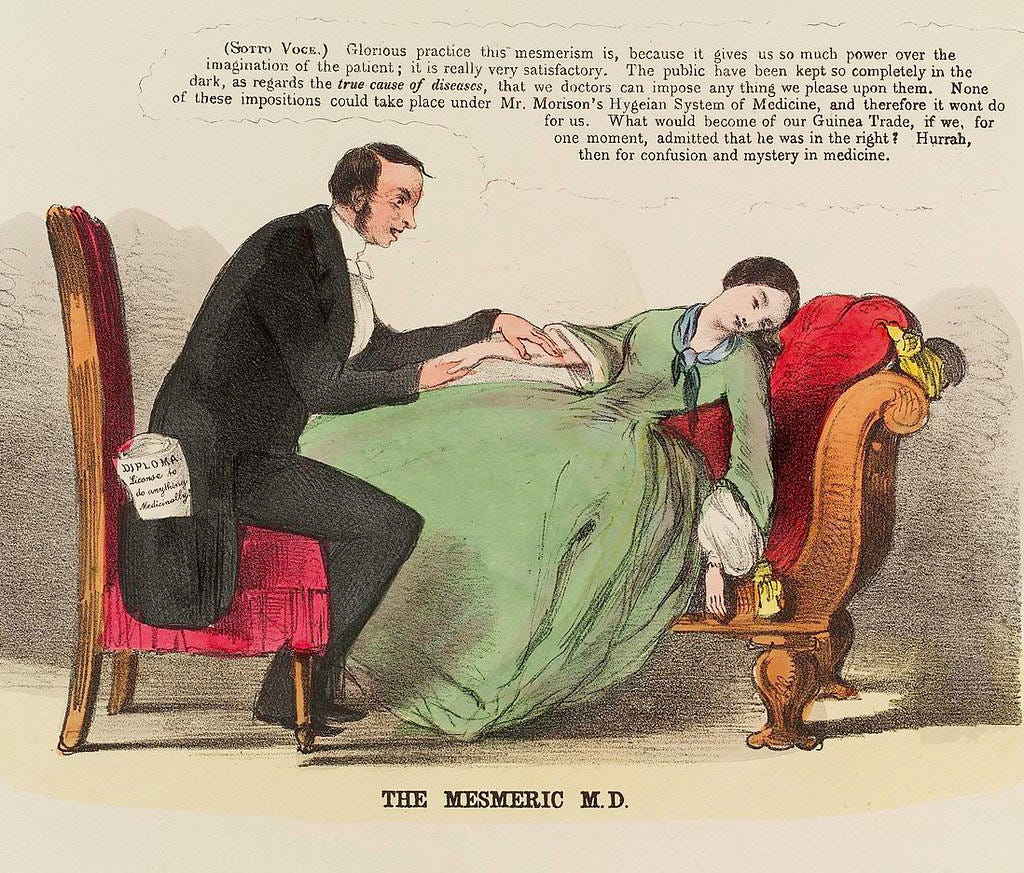
This definitely applies with hypnotism, which has always existed in a kind of uneasy space between “science” and the far dodgier realm of the occult.10 Of Franz Anton Mesmer, the originator of hypnotism’s precursor form of mesmerism, Ichiyanagi remarks:
Underpinning Mesmer’s theories lay long-existing shamanistic practices such as healing by laying on of hands or by the power of suggestion, as well as the theory of “animal magnetism” that goes back to [the Renaissance-era Swiss physician] Paracelsus. Mesmer himself, however, believed without a shadow of a doubt that his therapeutic method was the product of pure science.11
Maybe he did, but that doesn’t mean it was. It’s also true that a lot of Mesmer’s subsequent disciples took the notion of “animal magnetism” in some out-there directions:
Mesmerism rapidly moved toward the metaphysical and the spirit world […] Some who were mesmerized were able to see the contents of a closed box, were able to predict the future, or developed telepathic powers.12
So this is why you need to take the above claims about hypnosis being “scientific” with a gigantic helping of salt. In terms of its practical development, and certainly by the late 19th century in Japan, the range of things that “hypnosis” was believed to be able to do was quite broad and definitely included things that would fall into the realm of ‘magic.’
That provides useful context to what’s going on when authors such as (e.g.) Andrew Adams and Ashida Kim write the below:
These magical in-signs [i.e., kuji] made with the fingers were used by ninja to hypnotize an adversary into inaction or temporary paralysis of action.13
HYPNOTIC HAND MOVEMENTS […]
These magical in-signs created by knitting the fingers together may be used to restore one’s confidence in moments of stress, or to hypnotize an adversary into inaction or temporary paralysis.14
Uh, no. The “hypnotize an adversary” thing both authors are describing is simply magic by a slightly different name. There’s literally a spell in Dungeons and Dragons that does that. I mean, it doesn’t strike me as implausible that doing kuji could have some psychological effect on the person who did it, but the idea that it could induce a physiological effect as severe as temporary paralysis in an unwilling subject…yeah, that’s nonsense.
You see what I mean when I say that in this context “hypnotism” is basically just a modern, updated word for “magic.”
That said, the Western authors above did not come up with the basic idea themselves. They were, as many ‘ninja’ authors do, mostly copying what their Japanese interlocutors told them. So, for next time, let’s look at how “hypnosis” played out in Japan around the turn of the 20th century, just as ‘ninja’ writing was getting going.
To be clear: hypnotism does appear to have some kind of medically beneficial effect and has been studied scientifically since the period in question. That’s not what we’re talking about here. I’m not talking about the much more limited set of claims regarding the scientific evidence for e.g. hypnotherapy; I’m focusing instead on the notion of “hypnosis” as it was used in practice during the late 19th and early 20th centuries in Japan.
Ichiyanagi, Saiminjutsu no Nihon kindai (1996), p. 43. Because of post length limits, I don’t have room to include the Japanese text today, unfortunately.
Ichiyanagi, Saiminjutsu no Nihon kindai, p. 16.
Gluck, Zen Combat (1962), p. 112.
Hayes, The Mystic Arts of the Ninja: Hypnotism, Invisibility, and Weaponry (1985), p. 133.
Hayes, The Mystic Arts of the Ninja, p. 133.
Maybe this is a bit unfair - it’s probably not reasonable to expect Hayes to go in for historical linguistics. On the other hand, if you’re going to throw Japanese terms at your readers, you probably should check for historical accuracy. This also isn’t the only time Hayes appears to mistakenly assume a modern word is a medieval term - he’d done so before in a 1984 discussion of the lore of the kunoichi.
Gluck, Zen Combat (1962), p. 112. The slightly weird punctuation is per the original.
Hayes, The Mystic Arts of the Ninja, p. 133.
Ichiyanagi, p. 10.
Ichiyanagi, p. 11.
Ichiyanagi, p. 11.
Adams, Ninja: The Invisible Assassins (1970), p. 105.
Ashida Kim, Secrets of the Ninja (Berkeley Books, NY: 1981), p. 10. Funny how similar the language is to Adams’ book, isn’t it?
While there is no hypnosis scene in Enter the Ninja (1981), there is one in the very next installment — Revenge of the Ninja (1983). And it closely resembles the use of hypnosis (saiminjutsu) in Lustbader's The Ninja (1980): a woman (the love interest of the main protagonist) is hypnotised and made to do the dirty work for the villainous ninja. In Lustbader's novel, this is also associated with *kobudera* — yet another mystical concept tied to ninja lore. My guess is that most audiences would first have encountered the term through American Ninja (1985), though I suspect it made its way into that script via Lustbader's book. As for where Lustbader himself picked up the term — or whether he simply invented it — I genuinely don't know.
Also, I tried to do what Hayes, perhaps, should have done – I looked in an old dictionary of premodern (or late medieval) Japanese, namely João Rodrigues' Vocabvlario de Iapon... from 1630. There I found the word 'saimin': "Nome que se poem aos rapados, ou Bonzos que se acaba em sai." This could refer to a 'shaveling', perhaps with regards to 細民 (?). The dictionary is in roman alphabet, of course... Anyways, there is no word 'saimin(jutsu)' with the meaning 催眠(術) recorded here. I would consider this settled.
The relation of kujihō or mudras helping with toothache, I recall a doctor who also specialized in acupuncture once recommending that I press an acupressure point on the index finger, on the outer side of the nail to suppress a toothache. It strongly reminded me of mudra 'retsu' (it's often written with various kanji, 裂, 列, 烈 etc.) as described in various sources (e.g. 『忍術虎の巻』 from 1917, p. 168, or ).
The first time I ever heard of Saiminjutsu is through Stephen K. Hayes. What he wrote was about a type of "self-hypnosis" breathing exercise that made me go, "Okay, so Saiminjutsu is a fancy ninja take on meditating."
I had no idea about all this other stuff!