
Stranger Than Fiction
The offbeat humor of John F. Gilbey's "Secret Fighting Arts of the World"

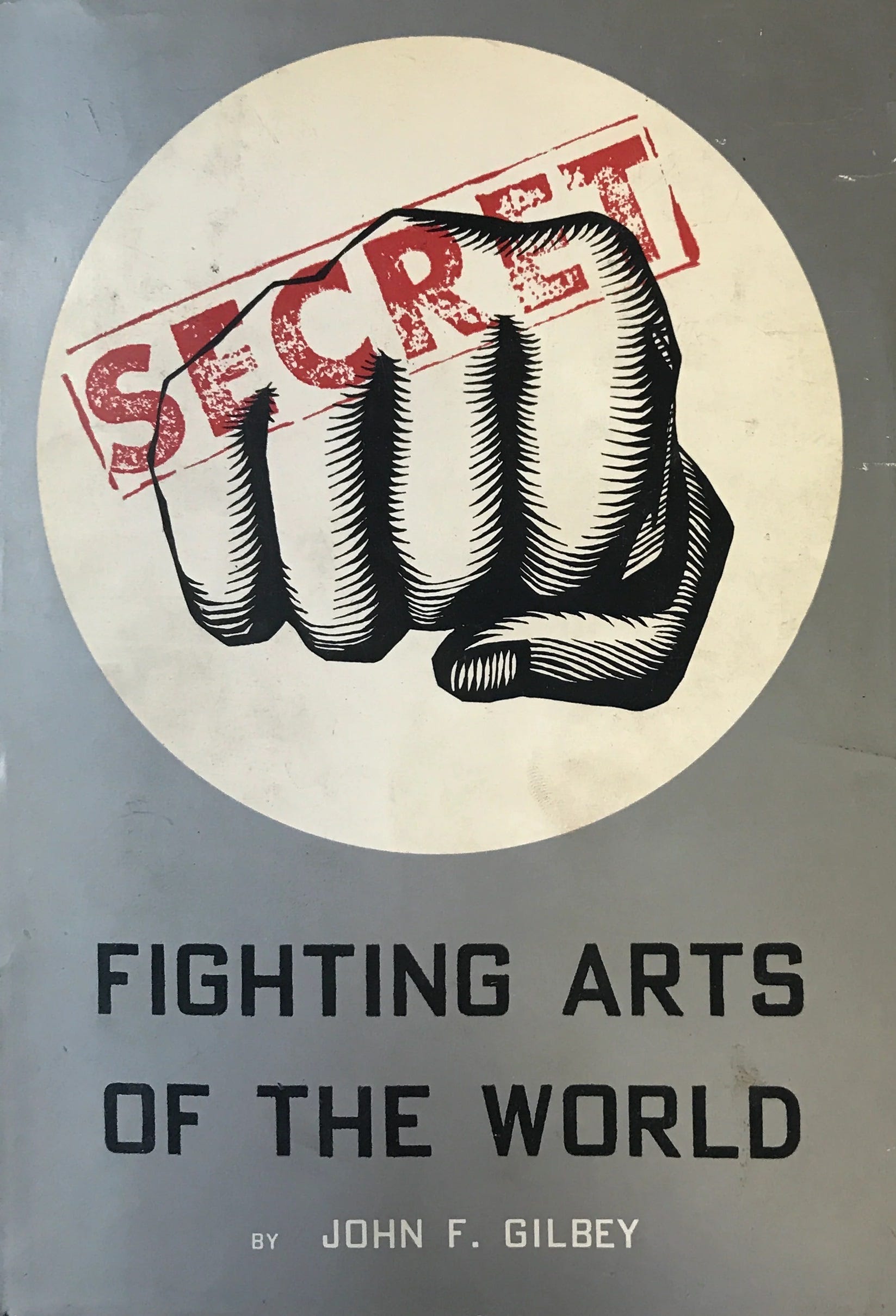
Secret Fighting Arts of the World, by John F. Gilbey, first saw the light of day in 1963 from our old friend Tuttle Publishing. As for what it’s about, I can do no better than to quote from the blurb on the back of the book:
AT LAST! Here is a book crammed full of secret fighting techniques never before divulged in print: the Oriental delayed death touch; the destruction wrought by the fingertips of an obscure Mexican; the shout of doom; the method so terrible it is practiced only in Russian torture chambers…
The average reader will find this book amazing - almost unbelievable. But many of the thousands of rugged young men currently practicing and writing about Oriental martial arts in the United States will find it invaluable. They know that such techniques exist, but have never before had the opportunity to learn them.1
And what of the author, John F. Gilbey? Well…
John L. [sic] Gilbey, a Ph.D. fluent in seven languages, is a world-renowned expert in self-defense, holding a 7th dan in judo, a 5th dan in karate, and a master’s certificate in Chinese boxing.2
Gilbey was a millionaire, heir to a textile fortune, and had written Secret Fighting Arts from Reykjavik, Iceland, where he was studying the Icelandic form of wrestling known as Glima. The book is a chronicle of his travels all over the world seeking out reclusive masters of the world’s most terrifying fighting techniques, among which are numbered the Ganges Groin Gouge, the Canton Corkscrew, and the dreaded Macedonian Buttock.
You Cannot Be Serious
OK, that last one is so ridiculous that it kinda gives the game away. Yes, Secret Fighting Arts of the World is mostly bullshit, a deliberate parody of outlandish martial arts stories and tales of reclusive yet lethal masters dwelling in the mountains. As for John F. Gilbey, he too was fictional, a collaborative effort among a few notable 1960s martial arts practitioners and writers, Americans Robert W. Smith, Jim Bregman, and Donn Draeger, and Dutchman Jon Bluming. Smith confessed all in his 1999 autobiography, Martial Musings:
John Gilbey was born in Donn Draeger’s house in Tokyo in 1961. Donn hit on the idea of giving me a textile millionaire doppleganger. Then Bluming and Bregman got in on the act, posing for a drawing, to lend verisimilitude to the story. Gilbey was a joke, an exaggeration, a fantasy. He had money, time, and amazing skill in everything. We were sure that readers would be smart enough to realize this. We were wrong.3
As concerns the ostensible focus of this newsletter, ‘ninja,’ Secret Fighting Arts has little to say. They’re mentioned only in the final chapter, in which Gilbey and one of his fictional friends save a Japanese man and his daughter from being run over by a car. The man is named Hirose Junzō, and out of gratitude Hirose lets Gilbey in on all of the amazing martial skills he has mastered. This, by incredible coincidence, includes ninjutsu, as Hirose just happens to be one of the few remaining living ‘ninja’ masters in Japan.
Aside from that little tongue-in-cheek moment Secret Fighting Arts doesn’t have a whole lot to say about ‘ninja,’ but I think it’s still relevant to our ongoing discussion here, for a few reasons. First, the fact that a deliberate parody gained a certain degree of traction among readers raises some interesting questions about martial arts publishing as a whole, a topic I’ve written about previously. Second, I have to say that Smith’s account of the parody and its genesis prompted me to re-think my evaluation of Donn Draeger’s influential 1971 book Ninjutsu. To be clear, I still think Draeger’s Ninjutsu is appallingly bad, but Smith rather changed my perspective on what Draeger may or may not have been trying to do in writing the book. The third reason is that, to be frank, I found Secret Fighting Arts very funny and felt that some of its content was worth sharing, because Lord knows most of us could do with a laugh these days.
In On the Joke
Much of the humor in Secret Fighting Arts is both subtle and deadpan, though it’s easier to detect once you know what you’re looking for. Like the cover, for instance. The edition I have is a 1995 one, apparently a sixth edition, and it looks like this:
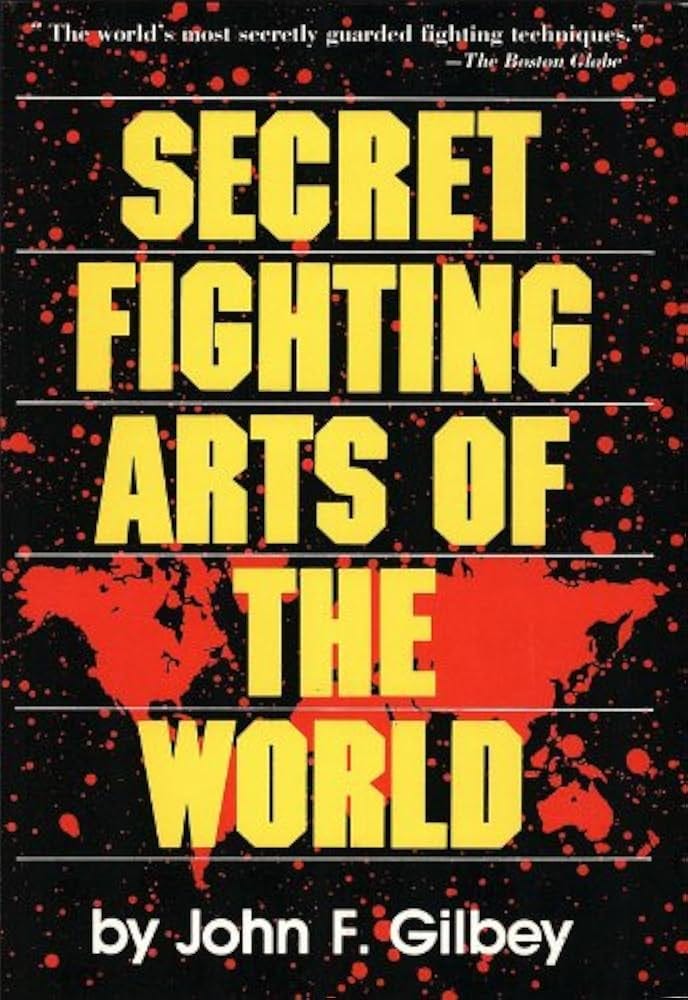
It’s a tasteful blood spatter motif, as you can see, but look more closely. See the bit at the bottom? It’s the world. In blood. Look, there’s Australia on the right-hand side.
Also, I’m not entirely sure about the Boston Globe blurb at the top, because:

Still. Let us begin our whirlwind tour with Ian Lindsey of the United Kingdom, master of the head-butt and therefore known as the “Liverpool Nutter.” Muses Gilbey:
I thought of the head-men I had known. In Korea you would expect the head tactic to reach a high science since most street fights resemble a contest between mountain goats. But it doesn’t. In China I had known one famous boxer, Lu An-to, who pounded large nails into two-by-fours with his forehead and yanked them out still perfectly straight, with his teeth. And yet other boxers depreciated this man who - in Chesterton’s phrase - “had a head you could break doors with.”4
“If J. Peterman from Seinfeld had written a book on martial arts,” one reviewer observes, “this would be it.”
From Liverpool we travel on to Benares and thence to the Ganges, to meet Srim Baba, master of the Ganges Groin Gouge:
Baba is a specialist and a real good one. His specialty is to attack in diverse ways that which is called in China “the golden target” and in America, “the family jewels.” […] It took two years of letters, gifts, influence, and pressure to bring about a meeting between us. But when we finally came together it was an electric four hours and worth all the trouble it took.5
Onward to Paris to meet Frenchman Henri Pougard, whose breath is so bad it constitutes a lethal weapon. This one, Gilbey candidly admits, he did not experience personally:
It happened to Donn Draeger, a truthful man certainly, and a man known across the globe for his research in the fighting arts. The below is culled from a letter Donn wrote to me in 1953:
“Jacques later introduced me to Henri Pougard […] [O]ne evening while we were sipping absinthe in his flat, I asked him the innocuous question that set his eyes to sparkling: how important was specialized breathing to efficient fighting?”
How important? So important that Henri has built an entire martial system around it, the Parisian Halitotic Attack:
Simply stated my art is to cultivate an evil breath which under certain circumstances (for instance, it will not work in a windstorm) I can direct at a human with drastic results. I had first to create the breath. This took two years of experimenting with various foods and herbs. During this time I tested my weapon against stray dogs and cats. Only when I was able to make them faint from ten feet in the open air did I feel competent to tackle humans.6
The Butt of the Joke
Then to Greece, where George Kostandis (no, not that one) teaches the Macedonian Buttock.
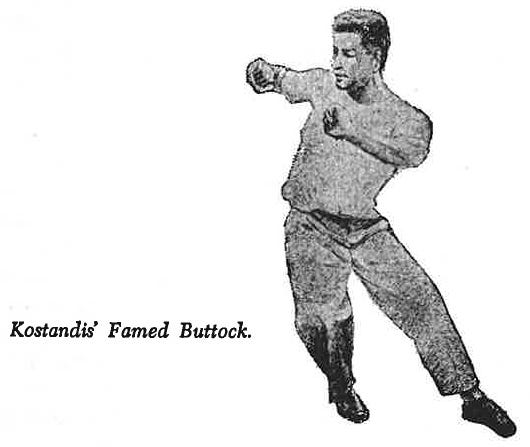
“The buttocks,” Gilbey tells us, “can be hardened admirably for use in striking”:
The student is first taught how to harden his buttocks. In standing and walking, he holds a coin between the parts which are pinched inward. This trick learned, the novice spends an hour a day banging his butt against a huge sandbag. […] The force generated is immense, and I saw many students actually thrown into the air by the swift undulation of an attacker’s buttock.7
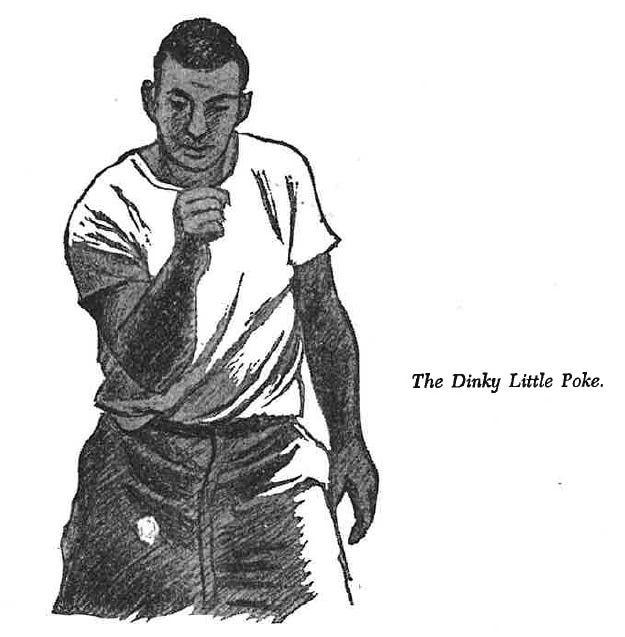
We could go on. We could go, say, to Peoria, Illinois, and meet a guy called Bill, who specializes in a technique known as the Dinky Little Poke.8 But I think you get the general idea.
Like a lot of Tuttle martial arts books, Secret Fighting Arts sold pretty well. My 1995 copy is a sixth edition, and Worldcat suggests two further editions came out in 2001 and 2011. There are also translations into Burmese (1969), Vietnamese (1986, 1995) and Russian (1991), all of which makes you wonder: how many of Gilbey’s readers realized the book was mostly a joke?
Quite a few clearly didn’t, as a rather bemused Smith relates in his autobiography. William Morris, a Hollywood talent agency, tried to make contact with Gilbey, and Smith/Gilbey ended up getting letters from readers. Like from the mother in Sweden, who was concerned for her son Sven:
Sven worshiped the martial arts and particularly its king, John Gilbey, whose first book was Sven’s Bible. One day at work in a machine shop, Sven’s lathe happened to jounce him slightly […] [T]he next day he couldn’t get up from his bed - in fact, one month later, Sven was still in bed telling his ma it must have been a delayed-action death touch like Gilbey mentioned.9
This letter was apparently forwarded on by Tuttle, who, if Smith’s account is to be believed, were worried about legal liability. Even more incredibly:
Gilbey also received a missive from a man who claimed Gilbey was his father, and several from applicants for a job at Gilbey Textiles Inc.10
Almost inevitably, a review in Black Belt magazine in May 1964 seemingly didn’t notice anything untoward, hailing Gilbey as having “lived the life of which many of us have dreamed.” The magazine recommended the book to a letter-writer seeking information a month or two later, then advertised it to its readers shortly after as an “authentic book…crammed full of secret techniques never before divulged in print.” Smith also notes that at least two serious books on the martial arts quoted from Gilbey without any obvious indication that they realized what the book was about.11
That said, not everyone took the book completely seriously, and on the whole it seems that a lot of readers just didn’t know what to make of Secret Fighting Arts. There was clearly something off about the book, but what exactly? A brief 1965 mention in a psychotherapy periodical (!), for instance, described Secret Fighting Arts as “Darndest collection of anecdotes and stories you ever read outside of Science Fiction,” and, much more stingingly, a 1977 publisher’s circular described the book as “a repulsive mixture of nonsense and myth (presented as fact) for the credulous customer.”
For next time, I’d like to dive a bit deeper into Secret Fighting Arts and the two subsequent books Smith published under the Gilbey pseudonym. I think it’ll be useful to consider what made them so effective as parody, and what Smith’s recollections might tell us about how to assess certain elements in the work of his good friend and co-prankster, Donn Draeger.
Rear cover blurb, John F. Gilbey (pseud.), Secret Fighting Arts of the World (Tuttle, 1995).
Gilbey, Secret Fighting Arts of the World, unnumbered frontispiece.
Robert W. Smith, Martial Musings: A Portrayal of Martial Arts in the 20th Century (1999); ebook, p. 185.
Gilbey, Secret Fighting Arts, pp. 23-24. The reference to G.K. Chesterton is an authentic one, if very slightly misquoted.
Gilbey, Secret Fighting Arts, p. 38.
Gilbey, Secret Fighting Arts, pp. 58-59. Italics in original.
Gilbey, Secret Fighting Arts, pp. 74-75.
Seemingly taken seriously by at least one martial arts website.
Smith, Martial Musings, pp. 187-188.
Smith, Martial Musings, pp. 189.
Smith, Martial Musings, pp. 189. If you’re interested, the authors are Richard Heckler, In Search of the Warrior Spirit and Michael Murphy, The Psychic Side of Sports.
This is very interesting in many aspects. The fact that the book is from 1963 suggests that the Martial Arts were *invented* earlier in the U.S. than in Europe (for something to be made fun of, it needs to be invented first). David Bowman in the 3rd chapter of his 2021 book The Invention of Martial Arts: Popular Culture Between Asia and America (https://www.researchgate.net/publication/347053486_The_Invention_of_Martial_Arts_Popular_Culture_Between_Asia_and_AmericaPopular_Culture_Between_Asia_and_America) maps the origin of Martial Arts as a cultural artefact in the West – he often refers to Great Britain, though. He suggests that the comedic view of MA is a thing of about mid 70s (at least in the Popular Culture), which is more than 10 years after Secret Fighting Arts first publishing. Perhaps (with reference to Tuttle), the popularity of the book illustrates sort of 'double-track' evolution of MA: The MA fans and practitioners' subculture (being naturally earlier) and later the general public's pop-culture.
Also, I can't help but remember the great James D. McCawley (a.k.a. Quang Phuc Dong of South Hanoi Institute of Technology) and his serious linguistic analysis of English sentences without overt grammatical subject (https://babel.ucsc.edu/~hank/quangphucdong.pdf). :-)
I just think that Draeger should have let Gilbey write that book on ninjutsu though, if you ask me. The chapter on Gilbey's birth is quite entertaining and one certainly wonders what happened to Sven, the victim of the death touch... He cannot have been convinced though since, as the story goes, he threw Gilbey's book into the trash.